
Who's liable when a solar installation goes wrong in WA
By Clara Tan · Updated 2026-07-02
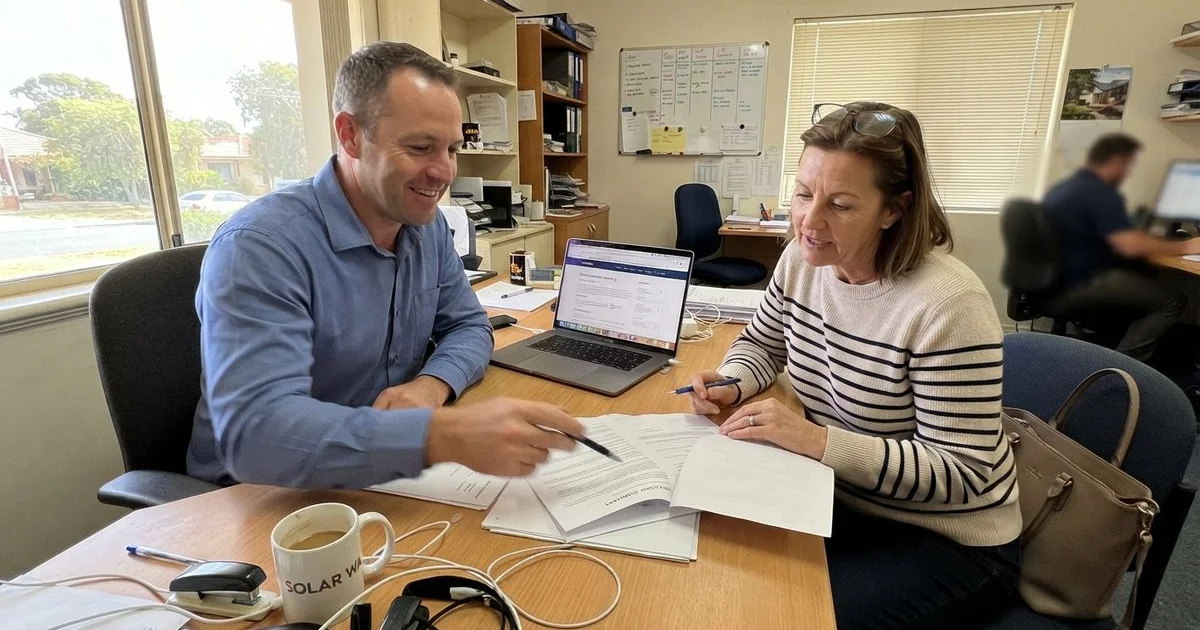
This is general information, not legal advice. For a specific dispute, contact WA consumer protection services or seek independent legal advice.
Most solar installations go smoothly, but when something does go wrong, working out who’s actually responsible can be confusing. Panels, inverters and batteries each carry manufacturer warranties, the installer carries a separate workmanship warranty, and the split between them isn’t always obvious until you actually need to make a claim.
The three layers of responsibility
Manufacturer warranty. Covers defects in the equipment itself, panels, inverter, or battery, regardless of who installed it. These warranties are usually the longest and are backed by the manufacturer, not your local installer, though your installer typically handles the initial claim on your behalf.
Installer workmanship warranty. Covers the quality of the installation itself: mounting, wiring, switchboard work, and whether the system was set up according to the design. This is where a fault caused by poor installation, rather than a faulty part, usually falls.
Consumer protection. Separate from both warranties, general consumer law covers issues like services not delivered as agreed, misleading claims, or a business failing to honour a written contract.
Where this gets complicated
A recurring pattern reported by solar customers isn’t a single dramatic failure, it’s a chain of smaller frustrations: a fault gets misdiagnosed, follow-up is slow, and it becomes unclear whether the issue is a manufacturer defect or an installation problem while nobody takes ownership of resolving it. Deposits held for extended periods without installation starting, and installations missing their agreed dates, are also patterns worth being aware of before you sign.
| Situation | Who is typically responsible |
|---|---|
| Panel underperforming due to a manufacturing fault | Manufacturer, via warranty claim |
| Wiring fault or incorrect mounting causing a problem | Installer, via workmanship warranty |
| Installer disappears or stops trading | Manufacturer warranty may still apply; workmanship warranty likely doesn’t |
| Deposit paid, installation repeatedly delayed | Consumer protection avenues, depending on your contract |

Documentation makes disputes easier to resolve
Take photos of the finished installation, the panel layout, the switchboard connection, the inverter mounting, before the crew leaves. Keep every piece of paperwork: the original quote, the signed contract, the compliance certificate, and any correspondence about changes made during the job. None of this guarantees a smooth outcome if something does go wrong later, but a dispute with clear documentation on your side is generally far easier to resolve than one relying on memory and assumptions about what was originally agreed.
Roof damage during installation
A less commonly discussed liability question is what happens if the installation process itself causes damage, a cracked tile, a leak that develops around a mounting point months later. Reputable installers carry insurance for exactly this kind of incident, and it’s reasonable to ask about their insurance coverage before work begins, not after a problem shows up. A written contract that specifies responsibility for installation-caused property damage protects you more than a verbal assumption that “of course they’d fix it.”
Protecting yourself before you sign
- Get the installation timeline, deposit amount, and balance payment terms in writing, not just verbally agreed.
- Ask directly how long the company has been trading and how workmanship warranty claims are handled if a fault appears years later.
- Confirm which manufacturer warranties apply to your specific equipment, not just a general assurance that “it’s covered.”
- Keep all correspondence, since a paper trail matters if a dispute does arise.
- Check the installer’s accreditation and licensing, since unaccredited work can put both your rebate and your workmanship warranty at risk.
If a dispute does happen
Start with the installer directly and put your concern in writing. If that doesn’t resolve things, WA’s consumer protection agency handles disputes involving services and contracts, and can be a useful next step. Choosing a well-established provider from the outset, and checking how warranty and aftercare support providers in Perth are reviewed for after-sales responsiveness, reduces the odds of ending up in this position in the first place.
It’s also reasonable to ask a supplier upfront how they’ve handled a past dispute or a difficult warranty claim. A company that answers with a specific example and a clear resolution is generally a better sign than one that insists it has never happened, since even well-run installers occasionally deal with a faulty batch of equipment or an unhappy customer.
Our methodology explains how after-sales responsiveness factors into our rankings, and you can compare providers from the homepage.
Questions people ask
- Who is responsible if my panels are faulty, the manufacturer or the installer?
- It usually depends on the fault. Manufacturing defects generally fall under the panel or inverter manufacturer's warranty, while installation faults, like poor wiring or incorrect mounting, are the installer's responsibility.
- What happens if my installer goes out of business?
- Manufacturer warranties on equipment can sometimes still be claimed directly, but installation workmanship warranties usually can't if the installing business no longer exists, which is why installer stability is worth considering upfront.
- Can I get a deposit back if an installer misses the agreed date repeatedly?
- Consumer protection rules generally allow you to pursue a refund for services not delivered as agreed, though the process and outcome depend on your specific contract and circumstances. A written agreement with clear timelines makes this easier to act on.
- Should I pay the full amount before installation starts?
- Most reputable installers use a deposit-and-balance structure rather than requesting full payment upfront. Being asked for the full amount before any work begins is worth treating cautiously.